

The Best Seat Covers For Toyota Tundra

The Toyota Tundra may spend one day commuting and the next towing a trailer, carrying a crew, or returning from a muddy trail. Those different uses create several kinds of interior wear at once: abrasive grit works into the upholstery, moisture and spills soak into porous surfaces, and repeated entry and exit rub the driver-side bolster.
The best seat covers for Toyota Tundra drivers are therefore not simply decorative accessories. They are a replaceable barrier selected for the truck’s most common risks, whether those risks are sharp-edged work gear, wet pets, children’s snacks, dusty clothing, or long hours behind the wheel.
The useful question is not whether one material is universally “best,” but which combination of fit, surface feel, liquid resistance, abrasion resistance, and cleaning effort suits the way the truck is actually used. CalTrend manufactures custom-fit Toyota Tundra seat covers around specific model years and seating configurations, so details such as split benches, headrests, armrests, consoles, and control access can be accounted for.
That vehicle-specific approach reduces loose fabric and exposed areas, helping the covers function as part of the cabin rather than looking and feeling like a generic layer placed over the seats..
Why Toyota Tundra Owners Need Seat Covers
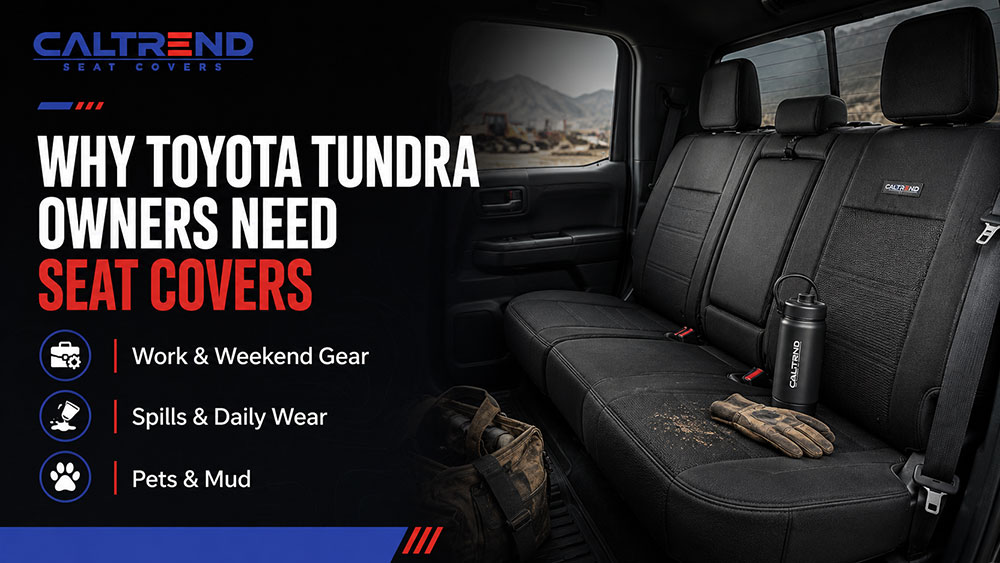
Full-size pickups experience a different pattern of wear from vehicles used only for light commuting. The best seat covers for Toyota Tundra trucks should address the particular combination of abrasion, dirt, moisture, passenger traffic, and cargo contact that occurs in the owner’s routine.
Identifying where the damage is most likely to happen helps determine whether the priority should be maximum toughness, easy wipe-down care, passenger comfort, or a balanced material that can handle several roles..
Work Use Can Damage Factory Seats
Work use concentrates damage on the outer edge of the driver’s seat because that is where clothing, belts, tools, and boots make contact during every entry and exit. Fine dust and sand can also settle into the seat surface and act like an abrasive when the driver moves. A durable cover takes that friction before it reaches the factory upholstery, and it can be removed for more thorough cleaning when a job leaves behind grease or debris. Contractors should still avoid placing uncovered sharp hardware on the seat, because puncture resistance is not the same as puncture proofing.
Towing And Outdoor Trips Bring Mess
Towing and outdoor recreation often bring water, mud, sunscreen, fish odor, plant debris, and wet clothing into the cab.
A water-resistant or waterproof surface can make cleanup more manageable, but owners should also consider seam construction and coverage because liquid can reach the upholstery through gaps even when the face material resists moisture. If wet gear is a frequent issue, remove standing moisture promptly and allow both the cover and the seat area to dry.
This reduces the chance of trapped dampness producing odor beneath an otherwise protective cover.
Family Trucks Need Easy Cleanup
A family Tundra may need to handle spilled drinks in the morning, a dog in the afternoon, and adult passengers on the weekend.
In that setting, easy cleaning and a comfortable surface can matter more than the stiffest possible work-grade fabric. Rear-seat coverage is especially useful when children, pets, sports equipment, or luggage are regular passengers.
Seat covers do not replace a correctly installed child restraint or a protective mat where the vehicle and child-seat manufacturers allow one, but they can make routine crumbs, paw prints, and scuffs easier to manage.
Best Materials For Toyota Tundra Seat Covers
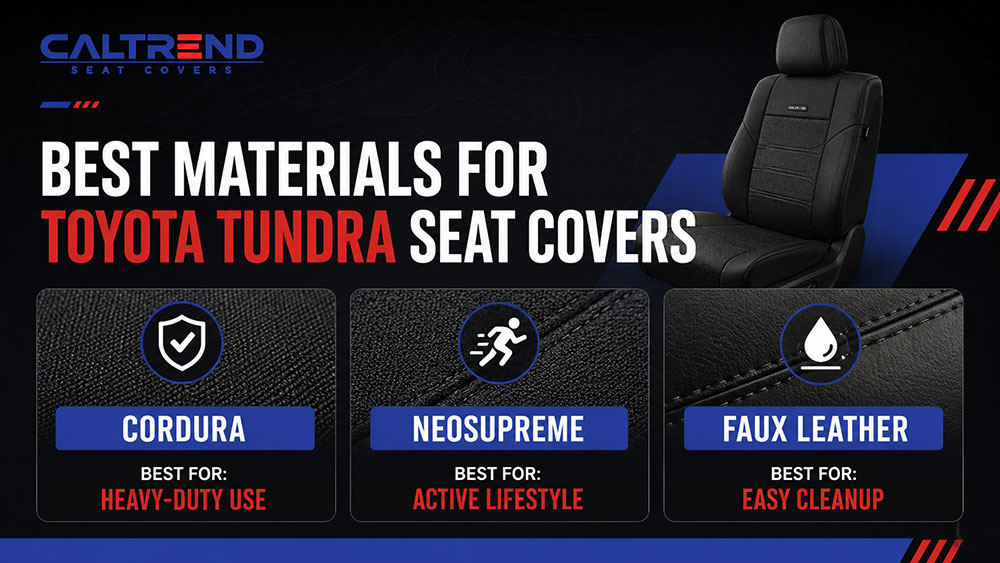
Material choice should be based on the most demanding regular use, not the rarest imaginable accident.
The best seat covers for Toyota Tundra owners balance four practical factors: how much abrasion the surface will receive, how often it will encounter moisture, how comfortable it feels for daily driving, and how much maintenance the owner is willing to perform.
A heavy-duty fabric may be ideal for a job-site truck but unnecessarily firm for a mostly urban daily driver, while a premium easy-clean surface may look excellent yet be the wrong match for exposed tools and rough cargo.
CORDURA For Heavy-Duty Protection
Waterproof CORDURA seat covers are the most purpose-built choice in this guide for Tundras exposed to demanding work, wet equipment, active pets, or frequent outdoor use. The tightly woven surface is selected for durability and makes more sense when resistance to abrasion and moisture ranks above a soft, upholstery-like feel.
It can be especially useful on the driver’s seat of a work truck where denim, heavy clothing, and repeated entry create concentrated friction. Owners should clean embedded grit rather than allowing it to accumulate, and they should remember that even rugged fabric can be damaged by uncovered blades, screws, or sharp tool corners.
Saddle Blanket For Classic Truck Style
Saddle Blanket seat covers suit drivers who want a traditional pickup appearance and a textured woven seating surface rather than the feel of coated waterproof fabric. The material can be a practical middle ground for daily driving, ranch use, road trips, and moderate work duty because it emphasizes breathability, comfort, and visual character.
Its textured construction can also make dust and crumbs less visually obvious between cleanings, although debris should still be vacuumed before it works deeper into the weave. It is a better match for dry wear and everyday abrasion than for owners whose main concern is repeated soaking or liquid spills.
Faux Leather For Premium Easy Cleaning
Faux leather is a strong option when the Tundra functions mainly as a daily driver, client-facing work vehicle, or family truck and the owner wants a more finished cabin appearance. Its smooth surface generally makes fresh spills, dust, and pet hair easier to wipe away than they would be on a deeply textured textile.
The tradeoff is that smooth surfaces can feel warmer after sun exposure and may show scratches from sharp objects more readily than rugged woven materials. Drivers in hot climates should consider parking habits, cabin temperature, and whether breathability matters more than fast wipe-down care.
Why Custom Fit Matters For A Toyota Tundra
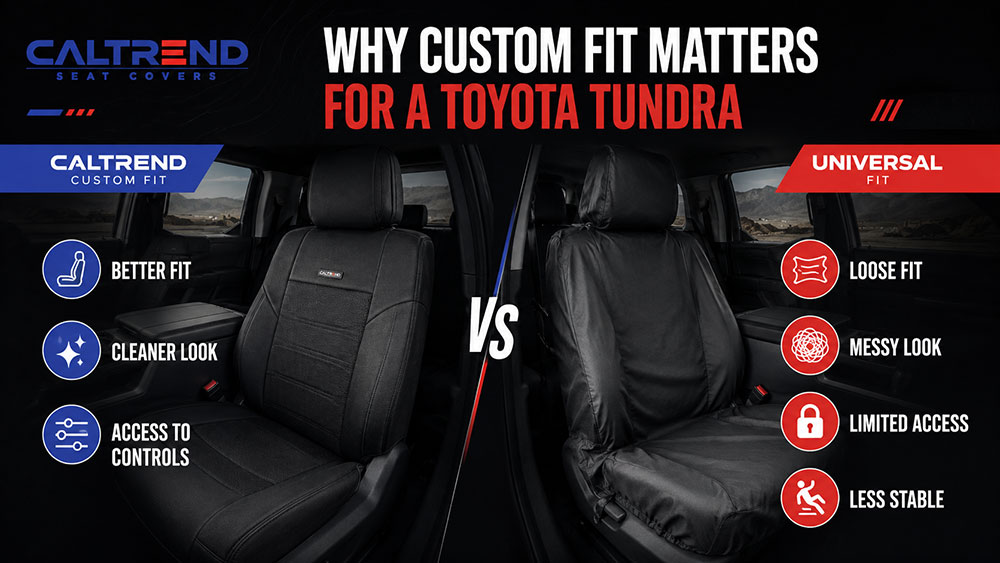
Material can only protect the areas it actually covers. The best seat covers for Toyota Tundra trucks need to correspond to the exact model year, cab and row layout, split configuration, headrest design, armrests, consoles, and relevant factory features.
A close pattern distributes tension across the seat and keeps openings where they belong, whereas an approximate fit can leave high-contact areas exposed or create folds that become uncomfortable during longer drives.
Full-Size Truck Seats Need Proper Coverage
Tundra seating is not one uniform shape across every year and trim. Front buckets, center sections, integrated or removable headrests, rear split benches, folding cushions, storage areas, and console arrangements all change how a cover must be cut and secured.
A universal cover may span the main cushion but still bunch around a bolster, block a release point, or leave sections exposed. A custom-fit set can use separate pieces where needed so the seat continues to fold, adjust, and provide access in the way the owner expects.
A Secure Fit Feels Better Every Day
Loose fabric moves each time the driver turns, brakes, climbs into the cab, or slides out of the seat. That movement can create wrinkles under the thighs or across the backrest, and the resulting friction can wear both the cover and the surface beneath it.
A secure installation keeps seams aligned with the seat contours and spreads pressure more evenly. After installation, owners should sit in each position, operate the seat through its normal range, and recheck the straps after several drives because new covers can settle slightly during initial use.
Vehicle-Specific Fit Looks More Professional
CalTrend’s Toyota Tundra Seat Covers are designed for specific vehicle and seat configurations, which allows the visible panels, attachment points, and component openings to follow the original layout more closely.
That matters visually, but it also affects day-to-day function: a properly matched cover is less likely to rotate, expose the outer bolster, or need constant readjustment. Before ordering, owners should identify the model year, trim, cab style, front and rear seat arrangement, headrest type, and any console or armrest details rather than relying on the vehicle name alone.
Choosing Tundra Seat Covers Based On Use
A useful buying decision starts with a one-week audit of the truck rather than a material name. Note who rides in each row, what commonly touches the seats, which messes occur, how long the truck sits in the sun, and whether the owner prefers quick wipe-down cleaning or periodic vacuuming. The best seat covers for Toyota Tundra owners are the ones that solve those frequent problems without creating a new annoyance such as excess heat, a rough feel, difficult cleaning, or restricted access to seat features..
For Contractors And Trades
Contractors and tradespeople should prioritize abrasion resistance, stable fit, and straightforward debris removal. The driver-side bolster usually needs the most protection because it receives the combined impact of work pants, belts, pockets, and repeated climbing into the cab.
A CORDURA-style option is often appropriate when the truck regularly visits jobsites, but it should be vacuumed or brushed so grit does not remain trapped on the seating surface. If the Tundra also transports clients, consider whether a heavy-duty texture provides the cabin feel you want before using the same material in every seating position..
For Outdoor And Towing Lifestyles
Drivers who tow boats, campers, off-road equipment, or utility trailers should think beyond the trailer itself and consider what comes back into the cab. Wet swimwear, muddy boots, campground dust, food, and gear straps can affect both rows. Moisture resistance is valuable, but comfort during long highway stretches also matters, so the most aggressive work fabric is not automatically the best touring choice. A practical setup may use stronger protection in the highest-risk seats while maintaining a more comfortable texture where passengers spend hours at a time..
For Family Daily Drivers
For a family daily driver, the priority is usually fast recovery from ordinary mess rather than resistance to industrial abuse. Faux leather or an easy-clean performance textile can simplify the removal of fresh spills, crumbs, pet hair, and dusty footprints while still looking appropriate for commuting. Consider rear-seat split functions and access points carefully if the family folds the seats or uses storage areas often.
Owners with pets should also evaluate claw resistance and surface temperature, while families using child restraints should follow both the Tundra manual and the child-seat manufacturer’s instructions when placing anything on or around the seat.
Cleaning And Care Tips For Tundra Seat Covers
Maintenance affects both appearance and service life. The best seat covers for Toyota Tundra trucks should be cleaned according to their specific fabric rather than with one all-purpose method, because woven textiles, coated waterproof materials, and faux leather respond differently to moisture, agitation, and cleaning products.
Frequent light cleaning is generally easier on a cover than waiting until dirt becomes embedded, and periodic fit checks prevent small amounts of shifting from turning into persistent bunching.
Vacuum Dust And Debris Often
Dust, sand, food particles, and dried mud can settle into seams and textured surfaces, especially after worksite or outdoor use. Vacuum the loose material with an upholstery attachment before wiping or scrubbing; adding liquid first can turn dry dust into a harder-to-remove residue.
Pay particular attention to the driver-side bolster, the crease between the cushion and backrest, and the rear seat after carrying pets or equipment. Avoid aggressive rotating brushes unless the cover manufacturer approves them, because they can pull at fibers or stitching.
Wipe Or Blot Spills Quickly
Blot a fresh spill before it spreads, then use the cleaning method recommended for the cover material. Scrubbing immediately can drive a liquid deeper into a woven surface, while soaking a cover can allow moisture to reach the upholstery underneath.
Test any unfamiliar cleaner on a hidden area and avoid assuming that a product safe for factory vinyl is also safe for every coated or dyed seat-cover fabric. For broader vehicle-interior practices, Consumer Reports’ interior cleaning guide offers a useful reference, but the care directions supplied for the specific cover should remain the primary instruction.
Check Fit After Heavy Use
Heavy entry and exit, folding rear seats, moving cargo, or sliding equipment across the cabin can loosen a strap or pull a panel away from its original position.
Inspect the cover after installation and again after the first few days of use, then include a quick fit check during routine cleaning. Recenter seams before tightening the retention system rather than pulling harder on one side, which can create uneven tension.
Keep straps and hooks clear of seat tracks, wiring, and moving mechanisms, and stop using any attachment component that appears stretched, broken, or poorly routed..
Safety And Vehicle Details Before Ordering
Protection is only successful when the seat continues to operate safely and normally. The best seat covers for Toyota Tundra models must match the correct seating configuration and leave required controls, belts, latches, storage access, and designed airbag deployment areas unobstructed. Owners should verify those details before ordering and repeat the functional check after installation instead of judging fit only by how the cover looks.
Confirm Your Seat Layout
Record the Tundra’s model year, trim, cab style, front-seat arrangement, rear-seat split, headrest type, armrests, console configuration, and powered or manual controls before selecting a cover.
Photos can help when two layouts have similar names but different shapes. Toyota’s official owner manuals and resources can help owners confirm factory features and operating instructions, while the seat-cover fitment process should be used to match those vehicle details to the correct pattern.
Do not assume that a cover fitting one Tundra generation or trim will automatically fit another..
Consider Seat-Mounted Airbags
Many modern vehicles use side-impact airbags that deploy from or near the seat, making airbag-aware design and correct placement essential. Never cover a deployment area with an improvised universal layer, add pins or hardware near it, or modify a cover to make an approximate fit work.
Confirm the relevant airbag locations in the vehicle documentation and use a cover designed for that seat configuration. For general safety context, the NHTSA air bag resource explains the role of vehicle airbags, but the Tundra owner’s manual and the cover manufacturer’s vehicle-specific instructions should guide the actual installation..
Keep Controls And Storage Accessible
After installation, operate every affected feature rather than checking only the driver’s seating surface. Move powered or manual seats through their normal range, fold and raise rear sections, open storage areas, adjust headrests and armrests, and confirm that seatbelt buckles remain visible and easy to reach.
Look underneath the seat to ensure straps do not cross moving tracks, wiring, or connectors. If a feature binds, becomes hard to access, or pulls the cover out of position, stop and correct the routing before regular driving..
FAQ
What Are The Best Seat Covers For Toyota Tundra?
The best option depends on the truck’s most frequent use. CORDURA is suited to demanding work, wet gear, pets, and abrasion; saddle blanket covers emphasize a breathable woven feel and classic truck styling; and faux leather favors a refined appearance with quick wipe-down care. Compare those strengths with comfort, climate, cleaning habits, and the exact seat configuration before choosing..
Are Custom-Fit Tundra Seat Covers Worth It?
They are often worth it when the goal is stable coverage and continued access to the Tundra’s seat functions. A vehicle-specific pattern can follow bolsters, split sections, headrests, armrests, and consoles more closely than a universal cover. The value is greatest when the owner plans to keep the truck, uses it heavily, or wants to preserve the original upholstery..
Are Waterproof Seat Covers Good For A Tundra?
They can be a strong choice for work, boating, pets, outdoor gear, and wet-weather use. However, verify whether “waterproof” refers to the face material or the complete cover construction, including seams and openings. Clean spills promptly and let damp areas dry instead of allowing moisture to remain trapped between the cover and factory seat..
Can Tundra Seat Covers Work With Heated Seats?
Many custom-fit covers can be used with heated seats when the product is approved for the vehicle and installed correctly. Thicker materials may slow how quickly heat is felt, and compatibility should never be assumed for heating, ventilation, sensors, or airbag systems. Check both the vehicle instructions and the seat-cover guidance for the exact Tundra configuration..
Should I Cover The Rear Seats Too?
Rear coverage is worthwhile if the truck regularly carries passengers, children, pets, tools, luggage, or outdoor equipment. It creates consistent protection across the cabin and can reduce uneven wear between rows. Make sure the rear covers preserve split-folding functions, buckle access, headrest movement, storage access, and any other features used in your particular Tundra..
Conclusion
The best seat covers for Toyota Tundra drivers are not defined by the toughest-sounding material alone.
They combine the right level of abrasion and moisture protection with a close vehicle-specific fit, acceptable comfort, manageable cleaning, and compatibility with the seat features the owner actually uses.
Start with the truck’s weekly routine, identify the highest-risk seats and messes, then choose a material whose tradeoffs fit that reality. A properly selected and installed set can take on daily wear while helping the original interior remain cleaner and better preserved..
Explore CalTrend’s Toyota Tundra seat covers to compare custom-fit protection for your truck’s model year, seating configuration, workload, and preferred material. Confirm every fitment detail before ordering, then follow the material-specific care and installation guidance so the finished covers remain secure, functional, and easier to maintain over time.

